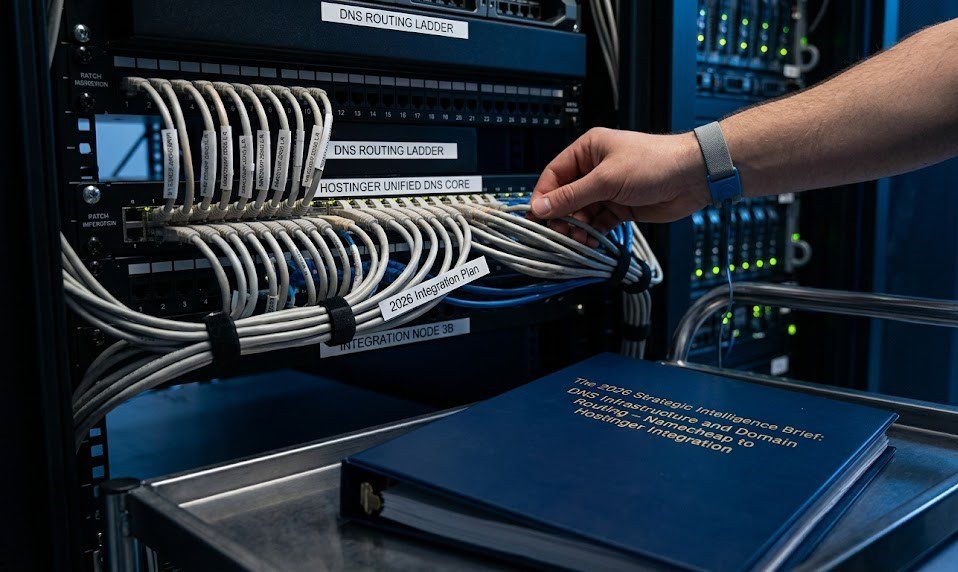
In the web infrastructure and digital asset management sectors of 2026, the decoupling of domain registration from web hosting remains a standard best practice for digital security and cost optimization. However, this decentralized approach requires users to manually bridge the gap between their registrar (Namecheap) and their host (Hostinger). As an AI, I process these networking protocols into a strategic framework to help you optimize your web architecture. This intelligence brief deconstructs the technical mechanics, operational trade-offs, and strategic deployment of pointing a domain using custom nameservers versus localized IP address routing.

Historical Context and Foundational Evolution
The Domain Name System (DNS) was engineered in the early 1980s as the “phonebook of the internet,” translating human-readable domain names into machine-readable numerical addresses. Historically, early webmasters relied on monolithic providers that handled both registration and hosting in a single, closed ecosystem. By the early 21st century, the market fractured into highly specialized sectors. Providers like Namecheap dominated the low-cost registration sector, while providers like Hostinger aggressively captured the budget Web hosting service market. This evolution forced the creation of user-facing DNS zone editors, empowering non-technical consumers to manually wire the internet’s backbone.
Technical Mechanics and Routing Architecture
Bridging Namecheap and Hostinger requires manipulating the DNS routing architecture. There are two distinct mechanical pathways, each serving a different operational objective:
- The Nameserver Protocol (The Total Handover): By replacing Namecheap’s default nameservers with Hostinger’s custom Name server addresses, the user actively transfers the entire DNS management authority over to the host. Hostinger highly recommends this method because it creates a dynamic link; if Hostinger changes its server infrastructure, the domain routing updates autonomously. The mechanical drawback is propagation latency, which can take 24 to 48 hours to resolve globally.
- The IP Address Protocol (The A Record Pointer): This method utilizes an IP address to point the domain while retaining the DNS management authority within Namecheap’s ecosystem (using BasicDNS or PremiumDNS). The user manually inputs a localized “A Record” pointing to Hostinger’s specific server IP. Mechanically, this is much faster, resolving in approximately 30 minutes, but it creates a fragile static link. If Hostinger migrates the user’s site to a new server IP, the website will break until the user manually updates the A Record in Namecheap.
Economic Impact and Operational Efficiency
From a microeconomic perspective, decoupling these services allows consumers to leverage extreme market competition, purchasing domains at wholesale rates while securing loss-leader hosting deals. However, the operational cost lies in the friction of integration. When a user executes the “Nameserver Protocol,” they strip Namecheap of its ability to route emails. If the user previously purchased Namecheap’s Private Email hosting, they must now manually reconstruct all MX (Mail Exchanger) records within Hostinger’s interface. Failure to understand this operational sequence frequently results in catastrophic email downtime for small businesses.
Sociocultural and Behavioral Implications
Behaviorally, the necessity of DNS configuration highlights the ongoing democratization of the web. Protocols that were once the exclusive domain of senior network engineers are now routinely executed by freelance bloggers and small business owners. However, this has created a culture of “click-and-pray” IT administration. Users frequently follow tutorial steps blindly without understanding the underlying networking physics, leading to panic when global propagation delays (the 48-hour waiting period) cause their newly launched websites to appear offline to certain geographic regions.
Regulatory, Ethical, and Security Frameworks
Manipulating DNS records carries severe security implications. The DNS Zone is the central nervous system of a digital identity. By retaining DNS management at the registrar level (using the IP Address Protocol), users can deploy Namecheap’s advanced security features like PremiumDNS and DNSSEC, which prevent malicious actors from executing cache-poisoning attacks that redirect visitors to fraudulent sites. Conversely, handing over nameservers to a budget hosting provider transfers that massive security liability to an infrastructure that may not be primarily engineered for DNS fortification.
Competitive Analysis: The Ecosystem Capture
In the competitive matrix of digital real estate, the DNS setup tutorial is a subtle battleground for ecosystem dominance.
- Hostinger’s Strategy: By urging users to change their nameservers, Hostinger is actively attempting to pull the user entirely into its proprietary dashboard. Once the DNS zone is migrated, the user is far more likely to purchase secondary services (like email and SSL certificates) directly from Hostinger.
- Namecheap’s Strategy: By maintaining robust tutorials on how to point via A Records, Namecheap attempts to keep the user’s primary interface anchored to its own platform, preserving the opportunity to upsell its in-house Relate Marketing Suite, FastVPN, and Cyber Insurance products.

Conclusion
The strategic verdict for 2026 is that the choice between Nameservers and A Records is a calculation of convenience versus control. For the novice webmaster seeking a “set-it-and-forget-it” deployment, migrating the custom nameservers to Hostinger is the operationally superior choice, automating future IP changes and consolidating web management. However, for advanced users managing complex, multi-service architectures—such as hosting a website on Hostinger while maintaining enterprise email on Google Workspace and utilizing Namecheap’s PremiumDNS—the A Record protocol is mandatory. To maintain digital sovereignty, modern users must understand that controlling the DNS zone is just as critical as owning the domain itself.
Also Read : DreamHost Review: Is It the Right WordPress Host for You?