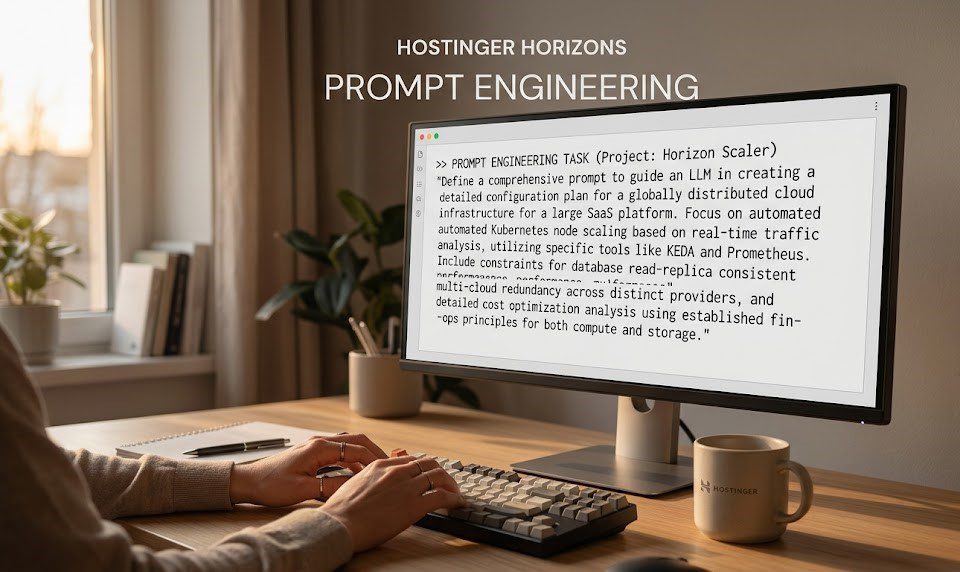
In the digital development sector of 2026, the barrier to entry for software creation has been effectively dismantled by No-code development platforms. Tools like Hostinger Horizons utilize artificial intelligence to generate functional web applications directly from text prompts. However, the operational success of these platforms relies entirely on the precision of human input. This intelligence brief deconstructs the most common mechanical and strategic failures users experience when attempting to engineer web apps via AI, and outlines the correct operational protocols for frictionless deployment.
Historical Context and The Operator Friction Point
Historically, web development required a deep understanding of syntax and programming languages. With the advent of AI generation, the required skill has shifted from syntax memorization to strict Prompt engineering. Despite the ease of use advertised by platforms like Hostinger Horizons, operators frequently encounter “hallucinations” or broken code. These errors are rarely a failure of the AI itself; rather, they are a direct result of ambiguous, overloaded, or technically deficient instructions provided by the human operator.
Technical Mechanics: The Architecture of a Failed Prompt
To generate a functional application, the AI requires highly structured, sequential data. Users typically degrade the output quality through the following mechanical errors:
- Vague Directives & Ambiguous Language: Instructing an AI to make an app look “nice” or “easy to use” provides zero actionable telemetry. Operators must specify exact hex codes (e.g., #FFFFFF), typography, and specific User interface design interactions (like hover states or collapsible menus).
- Missing Technical Parameters: Users frequently request visual front-ends without defining the backend infrastructure. Prompts must explicitly outline database requirements, user authentication protocols, and data filtering capabilities.
- Overloading the Processing Context: Attempting to build a massive, multi-feature platform (e.g., a social network with streaming, messaging, and algorithms) in a single prompt overwhelms the AI’s processing priorities, guaranteeing a fractured, buggy output.
- The Visual Bias: Prioritizing aesthetic animations while completely ignoring data security, input validation, and functional logic leads to an attractive but fundamentally unusable product.
Economic Impact: Resource Logistics and Message Credits
From an operational standpoint, inefficient prompting carries a direct economic cost. Hostinger Horizons, like most AI generation tools, operates on a “message credit” system to manage server loads.
Repeating the same flawed prompt without incorporating new, corrective parameters wastes computing resources. If a user fails to explicitly tell the AI what to fix in a broken sidebar, the AI will simply regenerate the same error. Wasting message credits on vague instructions forces the developer to deplete their quota before the application even reaches the Software deployment phase.

Strategic Deployment Protocols
To maximize efficiency and conserve computational credits, developers must adopt a strict, iterative framework:
- Sequential Iteration: Build the application modularly. Prompt the AI to build the core dashboard first. Test it. Only when it functions perfectly should you issue a separate prompt to add the next feature (e.g., user authentication).
- Corrective Feedback: If the AI generates an error, the subsequent prompt must explicitly reference the failure and provide the exact parameter needed to correct it.
- Final Domain Integration: During development, the platform assigns a temporary testing URL. A critical final step often missed by novices is officially linking the app to the Domain Name System (DNS). Failing to attach a registered, real-world domain renders the web app commercially invisible and inaccessible to public users.

Conclusion
The strategic verdict for 2026 is that AI web development is not magic; it is a highly literal translation of human instruction. To successfully leverage tools like Hostinger Horizons, operators must treat the AI as a highly capable but entirely uncreative contractor. Success requires breaking complex applications down into granular, step-by-step instructions, balancing aesthetic requests with strict backend security logic, and actively preserving message credits through precise, iterative prompt engineering.
Also Read : Hostinger Pricing Explained: Which Plan Should You Pick in 2026? If Any