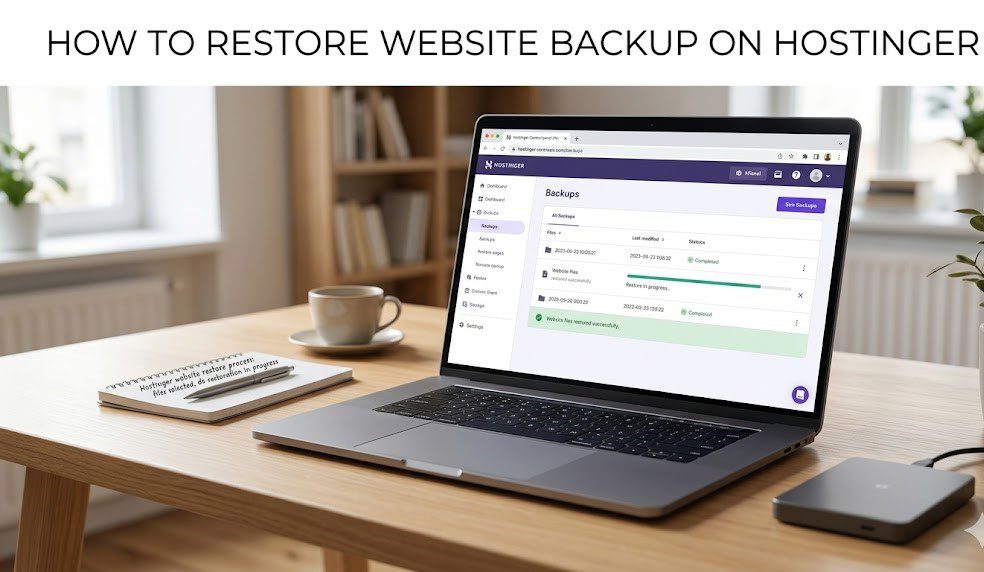
In the high-stakes environment of 2026 web management, a robust Backup strategy is the primary defense against data loss, Ransomware, and catastrophic plugin failures. As websites evolve into complex ecosystems of API integrations and dynamic content, the ability to “roll back” to a functional state is no longer a luxury—it is a foundational requirement for business continuity. This briefing explores the technical mechanics, economic necessity, and procedural frameworks of managing backups within the Hostinger hPanel environment, specifically focusing on the automation provided by the 2026 Business Plan.
1. Historical Context: The Evolution of Disaster Recovery
The history of web hosting has transitioned from manual, server-side FTP backups to the modern era of “Snapshots” and “Continuous Data Protection.” In the early 2010s, website owners were largely responsible for their own redundancy, often relying on unstable third-party WordPress plugins. By 2026, Hostinger has centralized this process through its proprietary hPanel. This shift represents a broader industry movement toward “Self-Healing Infrastructure,” where the hosting provider assumes the role of a data steward, providing automated daily backups as a standard feature for business-tier accounts to mitigate the rising frequency of digital disruptions.
2. Technical Mechanics: Differential vs. Full Snapshots
The mechanics of Hostinger’s daily backup system rely on “Snapshot” technology.
- The File System: When a backup is generated, the system creates a point-in-time image of the File system (public_html directory). In 2026, Hostinger utilizes NVMe storage to ensure these snapshots are created with zero impact on live site performance.
- The Database: Simultaneously, the system performs a dump of the MySQL or MariaDB databases. Because a modern website is a combination of files (media/code) and data (posts/settings), both must be restored in tandem to ensure the Data integrity of the site.
- Manual Overrides: Beyond the 24-hour automated cycle, the “Generate New Backup” feature allows users to create a manual restore point immediately before performing high-risk actions, such as core theme updates or database migrations.
3. Economic Impact: ROI of Business-Tier Redundancy
The Macroeconomics of web hosting suggests that “cheap” hosting often carries high hidden costs in the form of data loss.
- The Business Plan Value: Hostinger’s Business Plan, which includes automated daily backups, provides a significantly higher Return on Investment (ROI) compared to basic plans that require manual intervention.
- Labor Savings: For a 1500+ business fleet, the labor cost of manually backing up sites is astronomical. Automated systems reduce “Disaster Recovery Time” from hours to minutes, preserving revenue during critical sales windows and protecting the “Digital Equity” of the brand.
4. Sociocultural Implications: The “Peace of Mind” Mandate
In 2026, the Sociology of digital ownership has shifted toward a demand for “User-Friendly Empowerment.” Website owners, ranging from solo-entrepreneurs to large students, prioritize platforms that offer a “Safety Net.” The ability to “Break and Fix” a website—experimenting with new designs or plugins with the knowledge that a single-click restore is available—promotes a culture of digital innovation. This psychological safety encourages users to keep their software updated, which in turn improves the overall security health of the global internet ecosystem.
5. Troubleshooting and Ethical Guardrails: The 100% Stall
A common technical friction point in 2026 involves the “100% Stall” during migrations or restores, often seen with plugins like All-in-One WP Migration.
- The Culprits: This is typically caused by server-side constraints such as PHP max execution time or memory limits.
- The Fix: Strategic adjustments—increasing PHP memory to 512MB or using “Import from URL” protocols—are required to bypass browser-level timeouts. Ethically, hosting providers must provide transparent access to these settings to ensure users are not “locked out” of their own data during a restoration crisis.
6. Regulatory Frameworks: Data Sovereignty and GDPR
In 2026, the storage of backups is governed by strict GDPR and data sovereignty laws. Hostinger’s backup systems are geographically distributed across data centers in the US, Europe, and Asia. This ensuring that even in the event of a regional data center failure, an off-site copy of the website remains available. Furthermore, the “Restore History” log provides a critical audit trail for compliance officers, documenting exactly when and why data was reverted, which is a mandatory requirement for highly regulated industries like e-commerce and finance.
7. Predictive Modeling: The Future of AI-Driven Restores (2026–2030)
By 2030, we anticipate the transition from manual restores to AI-Predictive Recovery. Instead of a user noticing a site is “broken,” the hosting environment will use Machine learning to detect anomalies (like a sudden 404-error spike after a plugin update). The system will automatically suggest—or even execute—a “Shadow Restore” to a temporary environment, allowing the user to approve a fix before the public ever sees the error. The “Backup” will evolve from a dormant file into a proactive, intelligent version-control system.
Conclusion
The verdict for 2026 is definitive: Backups are the most critical component of modern web hosting, and automation is the only sustainable way to manage them. Hostinger’s hPanel provides a high-efficiency framework that balances the “Daily Automated” needs of a professional business with the “Manual Precision” required by developers. Whether you are recovering from a “broken” plugin or migrating a large-scale student project, the technical ability to select a specific date and initiate a full-system restoration is the ultimate safeguard. In the 2026 digital economy, the question is not if your site will encounter an error, but how quickly you can recover; those utilizing a structured backup protocol on a high-tier host like Hostinger are positioned to survive and thrive despite the volatility of the web.
Also Read : Hivelocity Web Hosting Review (2025) — Power, Flexibility & Enterprise-Grade Servers